Find your next puzzle
Enjoy color by number? Try a different way to build a picture.
The best alternative depends on what you enjoy: following a clear instruction, watching an image appear, or deciding where the next detail belongs. Jigsaw puzzles keep the picture-building pleasure and add a different question: where does this piece fit?
Read the guide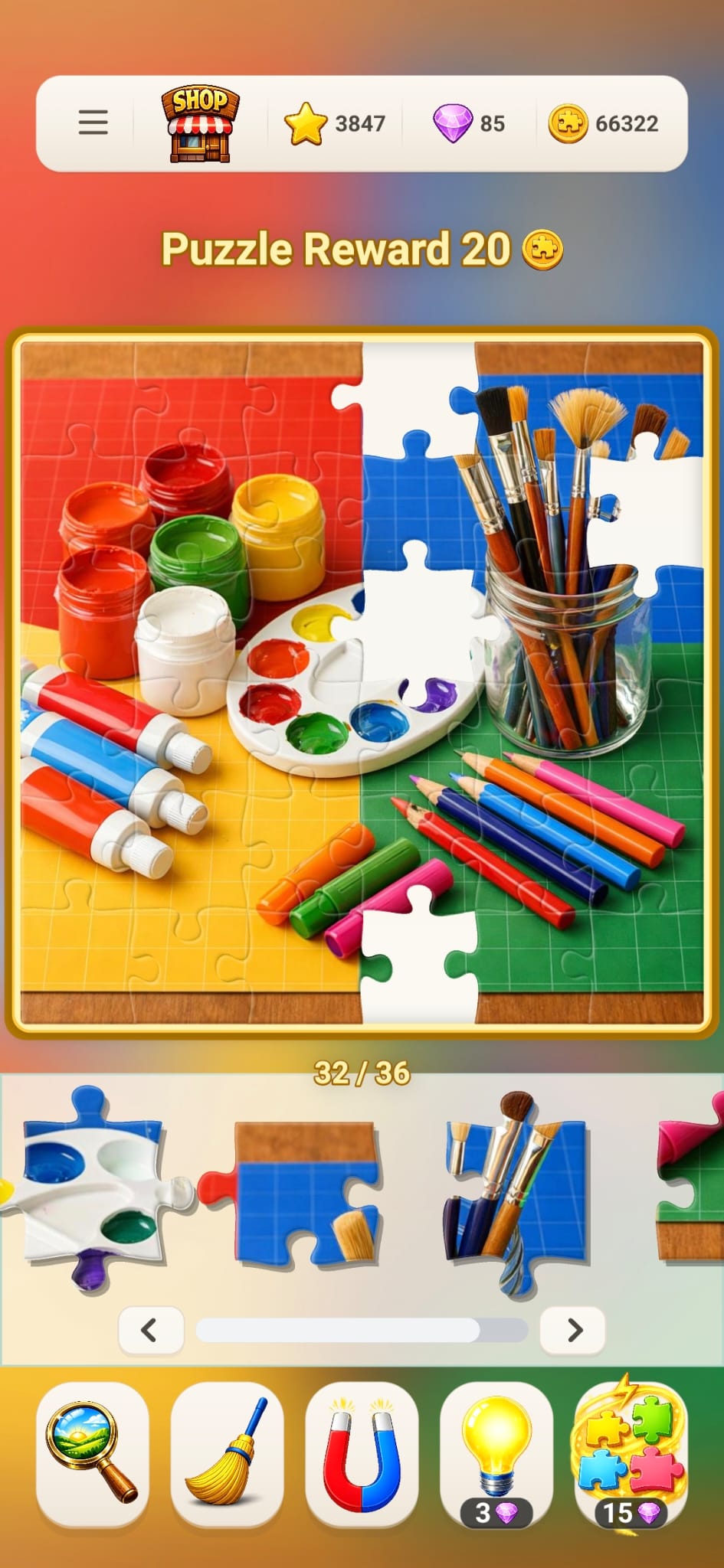
Start with the part of coloring you would like to keep
Think about your last enjoyable color-by-number picture. Was the satisfying part filling every tiny space with one color? Seeing an animal emerge? Or having a clear next action whenever you picked up your phone? Those are different preferences, and they lead to different games.
If you like a prescribed action with little uncertainty, another numbered activity may suit you best. If your favorite moment is recognizing how a small detail belongs to the whole picture, a jigsaw is a natural next experiment. If you want each decision to follow from a clue, try a nonogram. Enjoying one kind of picture puzzle does not mean you need to enjoy all of them.
Five ways to spend time with a picture
| Activity | What you do | A good fit when you enjoy | Consider before choosing |
|---|---|---|---|
| Color by number | Match numbered areas to their assigned colors. | A clear instruction and a gradually filled image. | Small regions can require close visual attention. |
| Pixel coloring | Fill cells in a grid, often using a numbered palette. | Working through small, regular units. | The grid is part of the picture's appearance. |
| Sticker by number | Place illustrated shapes into numbered spaces. | Putting recognizable objects into a scene. | Available controls and placement rules vary by game. |
| Nonograms | Use row and column clues to decide which grid cells to fill. | Deducing a picture from logical constraints. | You will need to learn how the clues work. |
| Jigsaw puzzles | Place pieces using image details, position, and shape. | Searching, matching, and assembling a picture. | A piece's destination may take some investigation. |
Free coloring is another option if choosing the palette is what you miss. It gives you more visual freedom, while numbered activities supply more direction. These categories describe common approaches; the details of an individual app can change the experience considerably.
What changes when you move from coloring to jigsaws?
In color by number, a label usually tells you which color belongs in a region. In a jigsaw, the fragment itself supplies clues. You might recognize a brush handle, the edge of a paint jar, or a line where a yellow surface meets a blue one. Your next action comes from noticing a relationship.
The art puzzle pictured here is a useful example. The paint jars, brushes, palette, and pencils create several recognizable areas. A piece containing both a pencil and part of the green background offers more information than a piece showing a single plain color. Looking for those boundaries gives you a practical starting method.
Color is still helpful, but matching blue with blue is only the beginning. Check the direction of a line and whether the neighboring image continues naturally. This extra judgment can be enjoyable if you want more choice about your next move. It can feel less comfortable if you mainly want a sequence of explicit instructions.
Choose a first jigsaw with clear visual landmarks
Choose a picture because you want to look at it, then check whether it gives you places to begin. Distinct objects, separate color areas, and a subject with a clear outline are helpful. An arrangement of art materials lets you work on the brushes or palette. An animal portrait might give you an eye, nose, or brightly colored detail to recognize.
For your first attempt, use a smaller piece count so that each piece contains a larger portion of the image. In Fun Journey, the available counts are 36, 64, 100, 144, 225, and 400. Starting at 36 lets you learn the picture-matching approach before adding more pieces. It does not set a deadline for finishing.
Build one recognizable object, then use its position to understand nearby pieces. If a section becomes repetitive, move to a different landmark. You can learn from the experience without completing the whole image in one sitting.
When a jigsaw may suit you—and when another activity may fit better
A jigsaw may suit you if you like finding details, choosing which area to work on, and seeing separate fragments become a continuous image. The visual progress is easy to recognize: an object becomes complete, a gap closes, or two parts of the scene connect.
Color by number may remain the better choice if you especially value being told exactly which area to fill next. Free coloring may suit you better if inventing a palette matters more than solving a placement problem. Nonograms may fit if you prefer decisions you can explain through a set of rules.
Try the same kind of subject across activities—a flower arrangement, a pet, or a landscape—and notice which repeated action you enjoy. Comparing a favorite picture with an unappealing one can disguise whether you actually prefer the game itself.
Exploring picture puzzles in Fun Journey
Jigsaw Puzzles: Fun Journey is an Android game with Daily, Journey, Collections, and Battle modes. If your interest starts with a particular picture, explore Collections. If you enjoy a daily prompt or a sequence to follow, look at Daily or Journey. Battle offers a different direction when competition is part of the appeal.
Begin with the art or animal imagery that catches your attention and a comfortable piece count. After one attempt, judge the actual interaction: did you enjoy examining pieces and deciding where to place them? That answer is more useful than assuming a jigsaw should feel exactly like coloring.
Questions before your next puzzle
What game is closest to color by number?
Pixel coloring and sticker-by-number activities often preserve the numbered, directed approach. Jigsaws preserve the pleasure of building a picture while asking you to work out placements. The closest fit depends on whether you value clear instructions or visual discovery more.
Are jigsaw puzzles harder than color by number?
They ask for different decisions. Color by number usually supplies the color for each labeled region; a jigsaw asks you to infer where an image fragment belongs. Piece count, image detail, screen size, and familiarity all affect how a jigsaw feels.
Can I choose the colors in Fun Journey?
Fun Journey is a jigsaw game: you assemble pieces of an existing image. If choosing and changing a palette is your priority, free coloring is a closer match.