Two ways to puzzle
Jigsaw puzzles or Sudoku? Choose the kind of decision you enjoy.
Sudoku asks which value the rules allow. A jigsaw asks where an image fragment belongs. Both reward careful observation, but the clues you follow—and the feeling of a good next move—are quite different.
Read the guide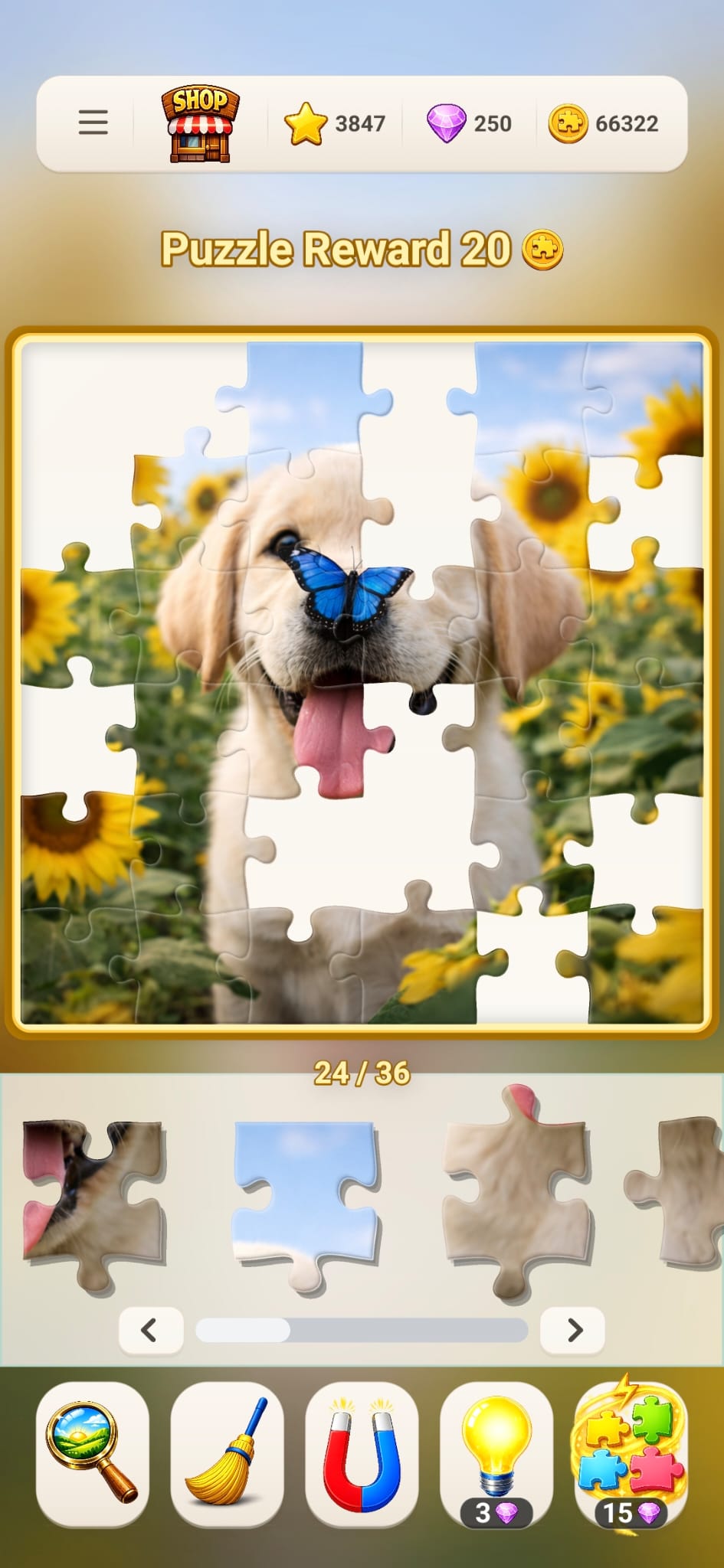
A rule-based deduction or a visual match?
In a standard 9-by-9 Sudoku, you fill the grid so that each row, column, and 3-by-3 box contains the digits 1 through 9 once. The numbers are symbols to arrange; ordinary Sudoku does not ask you to add or multiply them. A useful move follows from the values already present and the spaces that remain.
A jigsaw starts with a picture divided into pieces. You use visual details, the picture's layout, and the pieces' shapes to work out where they belong. A stripe might continue across two pieces, a straight edge might belong on the outside, or a recognizable face might help you locate a fragment.
If you like explaining why a square must contain a particular value, Sudoku may appeal. If you like recognizing how a small detail connects to a larger scene, a jigsaw may be a better fit for that moment.
How the experience differs
| What matters to you | Jigsaw puzzles | Sudoku |
|---|---|---|
| Your main clues | Color, texture, edges, shapes, and image position. | The digits already placed and the row, column, and box rules. |
| A typical next move | Find the piece that continues a feature or fills a particular gap. | Eliminate candidates until a value or position is determined. |
| Visible progress | Recognizable parts of an image become connected. | More cells are filled and fewer candidates remain. |
| What changes the difficulty | Piece count, repeated details, subtle colors, and how clearly you can inspect the pieces. | The deductions needed to move from the given clues to a solution. |
| What you look at | A chosen illustration or photograph. | A consistent grid of symbols. |
Neither format has a single pace. An easy Sudoku can offer a run of clear deductions, and a small jigsaw can offer obvious visual matches. A harder example of either can leave you examining possibilities before making progress.
Compare one actual decision
Imagine a Sudoku row with one empty cell. If the other eight cells contain 1, 2, 3, 4, 5, 6, 8, and 9, the missing value is 7. That is a deduction from a rule. In more complicated positions, you may need to consider several rows, columns, or boxes before the next placement becomes certain.
Now look at the puppy jigsaw shown here. A fragment with part of the blue butterfly and the puppy's dark nose points toward the center of the face. A piece with a sunflower and blue sky belongs to a different part of the picture. You compare the visible features and their relationships to choose a location.
Two pale pieces of fur might look similar, so color alone may not settle the question. Examine the direction of the fur, a shadow, or the continuation of the animal's outline. A jigsaw gives you several kinds of visual evidence to combine; Sudoku gives you a consistent set of logical constraints.
Choose difficulty separately for each puzzle type
Being comfortable with advanced Sudoku does not tell you which jigsaw piece count you will prefer. Sudoku techniques transfer to other Sudoku grids, while recognizing image fragments is a different activity to learn. Likewise, enjoying large jigsaws does not mean a difficult Sudoku will feel familiar.
With a jigsaw, change one thing at a time. Start with a clear subject at a small piece count, then try more pieces or an image with more repeated detail. A puppy's face and a bright butterfly give you distinctive landmarks; a large area of similar sky gives you fewer. The same count can feel quite different across those images.
Fun Journey offers 36, 64, 100, 144, 225, and 400 pieces. Treat those as choices about how much visual material to manage. There is no reliable conversion from a Sudoku difficulty label to a jigsaw piece count or completion time.
Let your preferences decide
Choose a jigsaw when the picture itself is part of the attraction, when you enjoy searching for visual details, or when you want to work on a recognizable object within a larger scene. It may suit you less if distinguishing similar colors or inspecting small fragments feels tedious on your screen.
Choose Sudoku when you enjoy a stable set of rules, working through possible values, and finding a placement you can justify. It may suit you less when keeping track of candidates feels like more effort than you want to spend. App controls, display size, and difficulty selection also affect the experience.
You can enjoy both for different reasons. Compare them by the actions you want to repeat today, rather than by claims that one makes you smarter or is universally more relaxing. This is a choice of pastime, and personal enjoyment is a useful measure.
A simple first step for Sudoku players trying jigsaws
Pick a picture with several distinct objects and choose a smaller count. Look for a few recognizable pieces before trying to organize everything. Build around one landmark, such as the puppy's face, then examine the boundaries around it. If you lose your place, return to the picture's overall layout and identify which area you are working on.
Jigsaw Puzzles: Fun Journey is available on Android and includes Daily, Journey, Collections, and Battle modes. Daily may interest you if you enjoy a recurring puzzle prompt; Collections may appeal when choosing the image comes first. Start by finding out whether placing picture fragments is enjoyable, then explore a mode that matches your preferred way to play.
Questions before your next puzzle
Does Sudoku require being good at mathematics?
Standard Sudoku uses digits as symbols, but solving it does not require arithmetic. The central task is arranging the digits according to the row, column, and box rules.
Which is easier: a jigsaw puzzle or Sudoku?
There is no single answer. Sudoku difficulty depends on the deductions needed; jigsaw difficulty depends on factors such as piece count and visual detail. Start with an approachable example of each and compare how the decisions feel.
Will Sudoku skills make me faster at jigsaws?
Familiarity with working through a puzzle may help you feel comfortable starting, but Sudoku techniques do not directly identify jigsaw pieces. Image recognition, sorting, and using visual landmarks are skills you learn through jigsaw practice.