When color stops being enough
How to solve difficult jigsaw sections: sky, water, fur and repeated colors.
Start at a boundary, follow the direction of the texture and use exact tabs and blanks only after the possible location is small. The same method turns a vague background into a sequence of testable clues.
Choose the section in front of you
The reliable order
Boundary → direction → shade → shape.
Begin where the difficult area touches something different: the horizon below the sky, the outline around an animal or a rock beside water. A boundary gives each piece a probable region and shows how the image should continue. Fun Journey pieces stay upright; use the direction of the pictured detail to judge their position.
Next compare texture direction and small shade changes. Only then filter by the exact arrangement of tabs and blanks. Shape is most efficient after visual clues have reduced the number of candidates.
Sky and water
Find the horizon before comparing blue pieces.
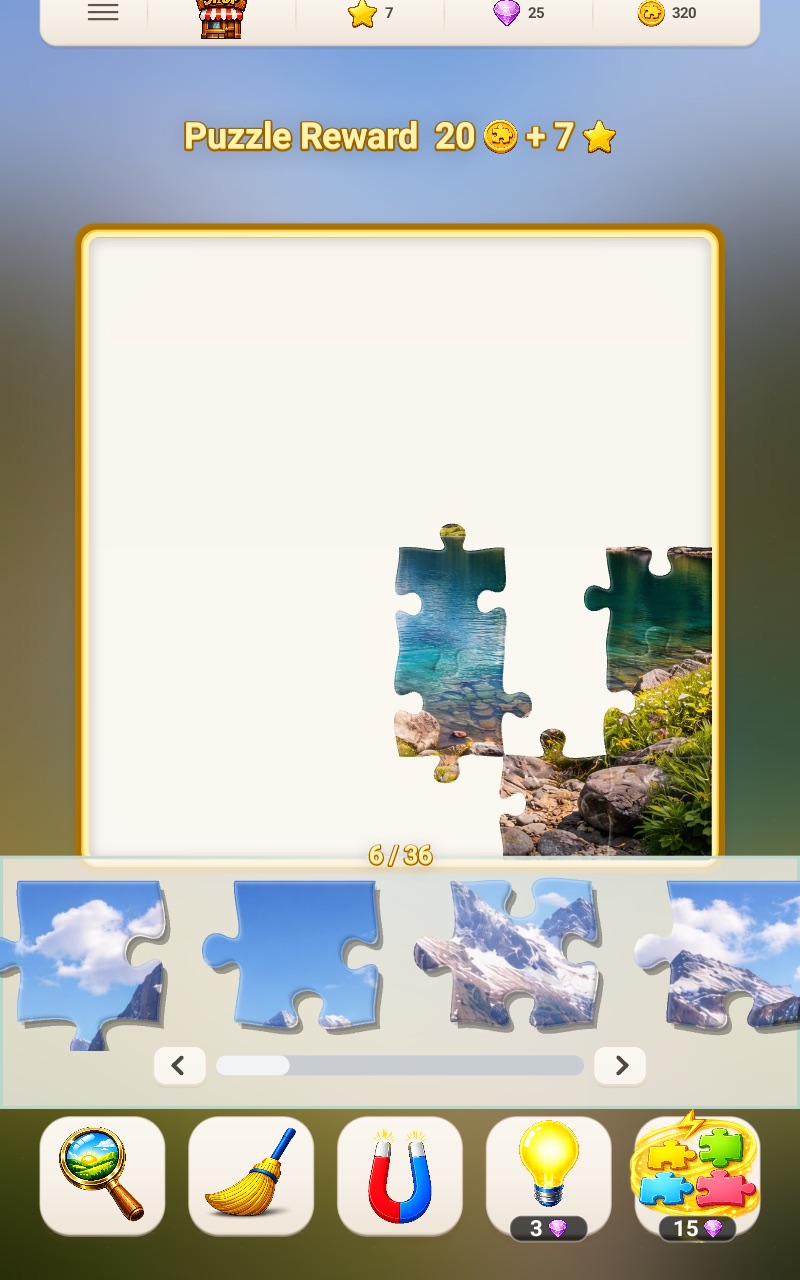
Start with pieces that cross a strong change: mountain against sky, shore against water or reflection against rock. Then look for the behavior of the blue. Sky often changes softly across a broad area, while water carries horizontal ripples, reflections or sharper value shifts.
- Group boundary pieces before uniform blue pieces
- Use cloud, ridge and shoreline fragments as anchors
- Compare light direction and color temperature
- Reserve nearly uniform pieces for the smaller gaps left behind
Fur and feathers
Follow growth direction, outline and anatomy.
Fur and feathers are not random texture. Strands curve around a face and feathers overlap in rows. Begin with the outer silhouette, eyes, beak, ears or another recognizable feature, then extend the texture in the direction it naturally travels.
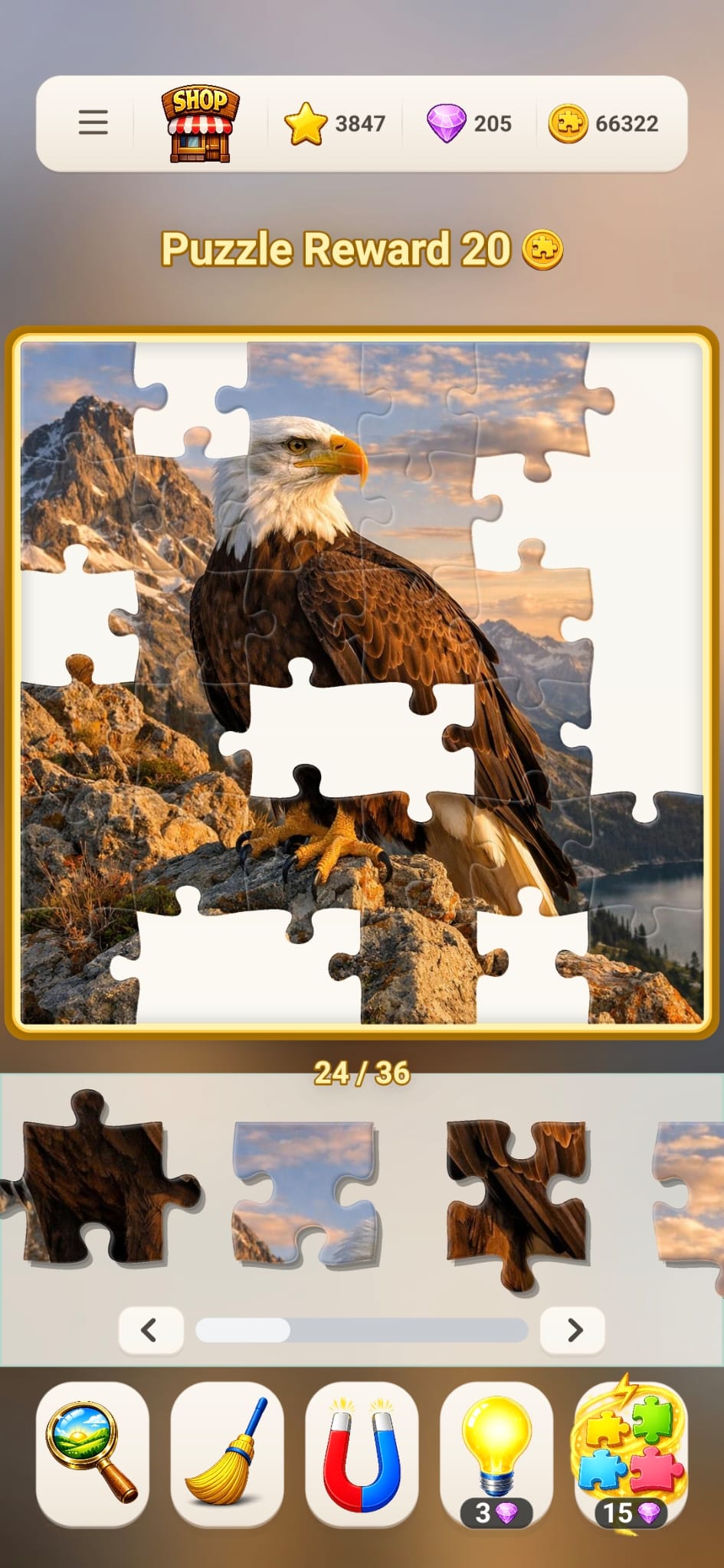
Separate highlights from shadow instead of making one large brown, white or cream group. On the puppy puzzle, the face, ears and sunflower boundary create anchors; on the eagle, the white head, dark body and wing edges divide the feather field.
Scales, waves and foliage
Trace the repeated pattern instead of matching its color.
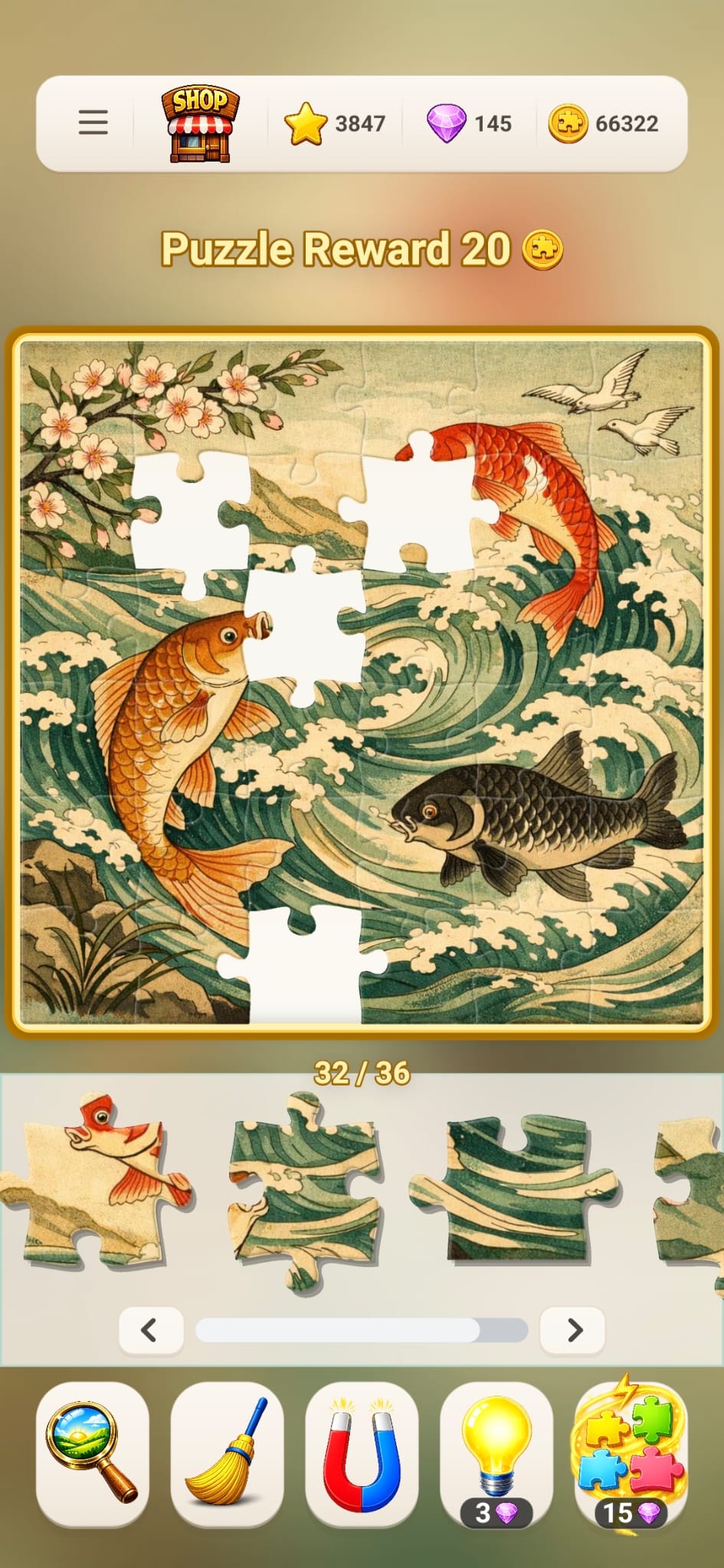
On the koi image, curved scale rows belong to a particular fish and the wave lines bend in a consistent direction. Match the continuation of those lines across an edge before comparing orange, black or green alone.
For leaves and foliage, build around stems, flower centers, rock edges or changes in leaf size. Repeated green becomes manageable when each group has a different line, boundary or scale.
The final uniform area
Let the empty spaces do the sorting.
When only repeated color remains, stop searching the whole board for each piece. Choose one empty space and describe exactly what it needs: location, tab-and-blank pattern, image direction and any faint line entering from a neighbor.
Scan the remaining tray only for that description. If several pieces qualify, compare tiny shade changes and edge continuity. A precise gap is a much smaller puzzle than a field of similar pieces.
Difficult-section questions
Use a different clue when one clue repeats.
How do I solve a jigsaw puzzle with a lot of sky?
Build the horizon, clouds and any mountain or tree boundaries first. Then sort the remaining sky by brightness, color temperature and exact shape.
What is the best way to solve fur?
Anchor the face and outer outline, then follow the direction and length of the fur. Separate highlight, midtone and shadow regions before searching by shape.
How do I handle many pieces of the same color?
Use line direction, texture, neighboring color and tabs and blanks to create a precise description. Search for one empty space at a time instead of testing every piece everywhere.
When should I use a hint?
First change your search question or move to another section. In Fun Journey, Preview, Edge Pieces, Sweep and Hint are available when you want help with a specific obstacle.