Read the shape
A piece shape is a clue. Learn what it can tell you.
An outward tab, an inward blank, and a flat edge each narrow the possibilities. Try the shape exercise below, then use this guide to understand why a candidate fits—and why a matching outline still needs the picture to agree.
Read the guide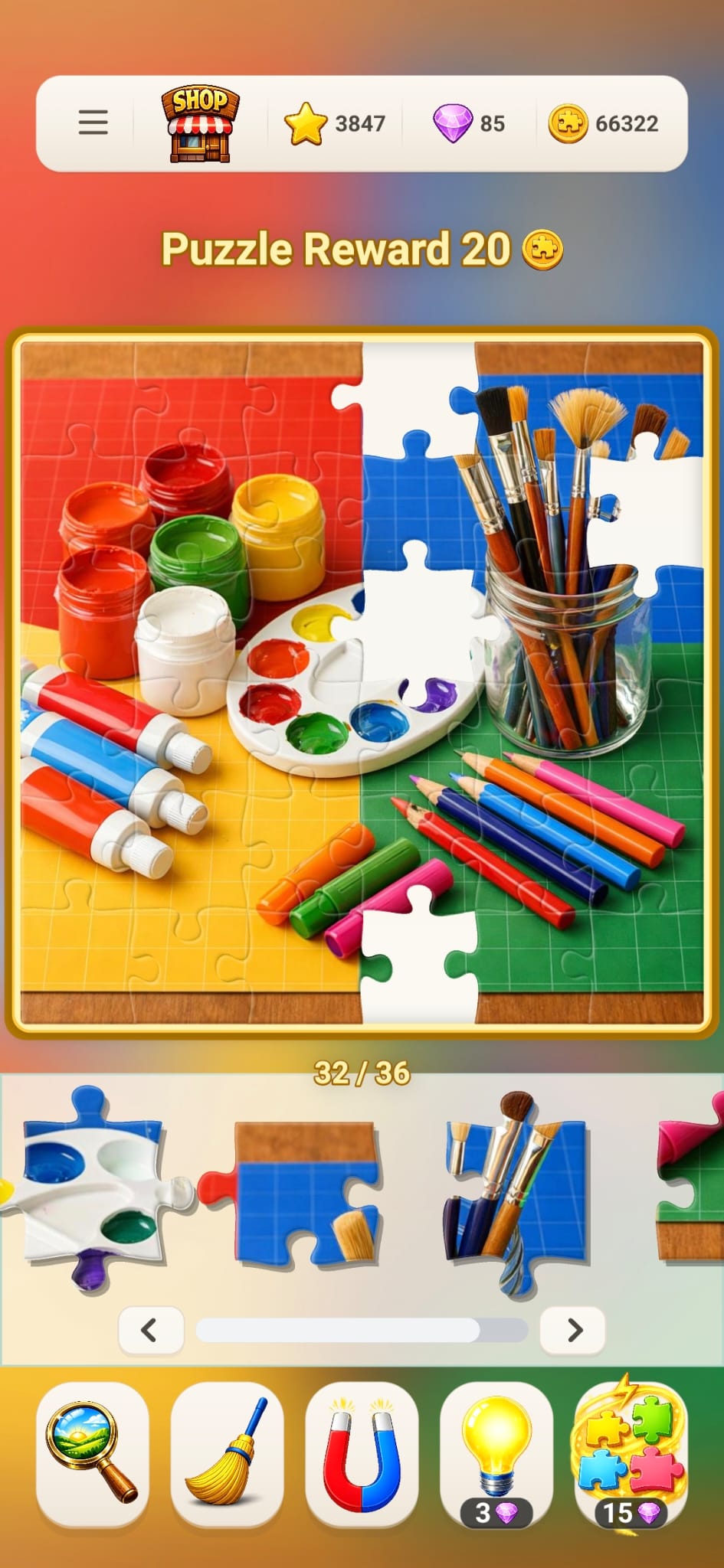
A small, hands-on exercise
Which piece matches this gap?
Compare each side, not just the number of tabs. All pieces stay upright. This is a shape lesson, not a playable version of the Android game.
A tab projects out. A blank curves inward.
The three boundaries in a classic jigsaw
A classic jigsaw piece has boundaries you can describe in a few words. A tab projects outward from the piece. A blank, also called an indentation or socket, curves inward to accept a neighboring tab. A flat edge has no interlocking tab or blank and, in a conventional rectangular puzzle, usually belongs along the outside of the picture.
These descriptions are relative to the piece you are examining. One piece's right-hand tab meets the next piece's left-hand blank. They describe opposite sides of the same join. When you inspect an empty space, remember that the visible boundary belongs to the surrounding pieces: a tab sticking into the space calls for a blank on the missing piece.
The exercise on this page isolates that relationship so you can practice reading it without searching through an entire picture. It is a website practice activity. Fun Journey itself uses illustrated puzzle pieces, where shape is one of several clues available to you.
Use flat sides to recognize corners and edges
In a standard rectangular jigsaw, a corner piece has two adjacent flat sides. Together, those sides form the corner of the finished picture. An ordinary edge piece has one flat side. An interior piece has no flat outside boundary. This makes flat sides a useful first sorting clue before you study the image in detail.
Direction matters as much as counting. A piece for the upper-left corner needs its flat boundaries on the top and left when viewed in its correct orientation. Two flat sides opposite one another do not describe that corner. Similarly, a piece with a flat top edge belongs somewhere along the top, but its color and neighboring features decide where along that row.
This rule describes conventional rectangular puzzles. Irregular outlines, specially shaped pieces, and other unusual cuts can follow different patterns. Check the intended shape of the finished puzzle before applying the border rule to every flat-looking line.
Read the gap before choosing a candidate
Suppose an empty space sits between two placed pieces. The neighbor on its left has a tab pointing into the space, and the neighbor on its right has a blank facing it. The missing piece therefore needs a blank on its left and a tab on its right. You have already ruled out candidates with the opposite arrangement, even before considering their colors.
Check every visible boundary, not just the first attractive match. A candidate may complement the left neighbor but clash with the piece above it. A border space adds another requirement: the side facing the outside must be flat. Each additional established neighbor gives you another condition the candidate must satisfy.
In the shape exercise, describe the gap in this order: top, right, bottom, left. Then describe each candidate in the same order. Using a consistent order makes it easier to notice the one side you might otherwise overlook. You can perform the same check silently while examining a physical or digital puzzle.
Two tabs and two blanks do not identify a unique piece
Counting tabs is a broad filter, not a complete match. Two pieces can each have two tabs and two blanks but arrange them differently. One may have its tabs on opposite sides; another may have them beside each other. The available gap determines which arrangement is relevant.
Even two pieces with the same arrangement can have different outlines. Compare a tab's width, its neck, its depth, and its position along the side. A narrow tab centered on an edge is different from a wider tab shifted toward one end. In a physical puzzle, small differences can matter even when two candidates look alike at first glance.
Repeated or similar shapes also occur, so do not assume the first plausible outline proves a placement. Shape helps you reduce the search. The image and the relationships to other pieces provide the remaining evidence.
Let the picture confirm the outline
The art-materials screenshot gives you a practical example. The upper gap interrupts the boundary between the wooden border and the blue surface. A candidate for that space needs both the appropriate outside edge and the same transition from wood to blue. A piece showing only blue may fit the general color area while failing to continue the border.
Another gap cuts through the brushes on the right. Here, the direction of a brush handle, the metal section holding its bristles, and the blue background all help. Trace a line toward the gap and ask where it should emerge on the other side. A candidate that bends a straight handle abruptly deserves another look.
Use three checks together: does the piece have the right boundaries, does its image belong in that region, and do the details continue across the join? When only one check works, leave the candidate available while you investigate another. You do not lose useful progress by keeping an uncertain match uncertain.
A doubtful fit is a reason to look again
With a physical puzzle, a piece that requires pressure, buckles its neighbor, or leaves an uneven seam should be reconsidered. Pressing harder does not supply evidence that the match is correct and can damage the pieces. Lift it gently and compare the contour and picture again.
On a digital board, forcing takes a different form: repeatedly dropping a piece into a place because its color looks close. Return to the visible clues. Does the shape agree with all the surrounding boundaries? Does an object continue naturally? If the picture breaks at the join, choose another candidate or examine a different gap.
Fun Journey's pieces stay upright, so its matching task centers on their position. In a physical puzzle you can turn a loose piece to inspect another orientation. Keep those contexts separate; this shape guide does not imply that the app has a rotation setting.
Turn the exercise into a useful solving habit
- Choose a well-defined gap. Begin where two or more neighbors already show the required boundaries.
- Describe the needed sides. Identify tabs, blanks, and any outside edge from the missing piece's perspective.
- Filter candidates by arrangement. Set aside shapes that cannot satisfy the visible neighbors.
- Compare the image. Follow a line, texture, or color boundary through the candidate.
- Recheck uncertainty. If a side or picture detail disagrees, examine another possibility.
You can make the first attempt easier by selecting a smaller puzzle with distinct objects. The art image has separate paint jars, brushes, and pencils; each offers features to trace. As you become more comfortable reading a gap, try one surrounded by similar colors and let the shape do more of the initial filtering.
The aim is to make your next choice easier to explain. You might say, “I need a left blank and a flat top, with a strip of wood above blue.” That description turns a tray full of pieces into a much smaller search without requiring a guess at every position.
Questions before your next puzzle
What are the parts of a jigsaw piece called?
The outward projections are commonly called tabs, and the inward spaces are called blanks, sockets, or indentations. A straight outside boundary is a flat edge. These names describe the shape relative to the piece you are looking at.
Does every jigsaw piece have two tabs and two blanks?
No. Tab and blank arrangements vary, and border pieces also have flat sides. Even pieces with the same number of tabs can arrange them differently, so check each side against the gap.
How can I tell an edge piece from a corner?
In a conventional rectangular puzzle, an ordinary edge piece has one flat outside side, while a corner has two adjacent flat outside sides. Unusual puzzle outlines and special cuts can differ.
Can two pieces have shapes that look the same?
Yes. Similar outlines can appear in the same puzzle. Compare the precise contour where you can see it, then check whether the picture continues naturally across every join. A broadly matching tab-and-blank pattern is only one clue.